
Thirty and 1 Day / Julia Haddad – Part One
I’m Julia Haddad, a teacher of children with autism spectrum disorder. It’s a job I’m passionate about and a source of positive energy for me—along with running. Here’s my story about running: how I got started, how I kept at it, and where it’s taken me:
In the 1990s, as you walked through the quiet alleys of our neighborhood in Amman, you might have seen a little girl running behind the walls of her house, in a small garage, kicking a ball with the artistry and skill of a professional player, or carrying a plastic gun and chasing after those playing the role of thieves, trying to catch them—that was me, Julia. A mischievous little girl who was rarely seen staying inside the house, I loved inventing new games and sharing them with my friends from the neighborhood. But the best of those friends—and my companion in all my adventures and mischief—was my brother, with whom I loved playing soccer even though he always beat me.
Thanks to my father, I learned to ride a two-wheeled bicycle at an early age; because he was worried about me around cars, he insisted that I ride only on the sidewalks. Those winding, uneven sidewalks laid the foundation for my mountain biking adventures on rough terrain when I grew up.

As for my school years, if you ever walked past the school I attended, you might have heard the PE teacher shouting at the top of her lungs, “Julia!” as she spotted me sneaking off to a spot out of her sight to spend the rest of the class away from her gaze and away from the slow, boring minutes of her lesson. P.E. was never one of my favorite classes; rather, I viewed it as a “filler class,” since the PE grade didn’t count toward my overall GPA. I often tried to skip it by pretending to be sick, especially on gymnastics days, when I was terrified of heights and my teacher didn’t understand the source of my fear or how to help me overcome it.
The demands of school and work then caught me off guard until I turned twenty-seven, when I went through a transitional phase in my professional life. During that time, I left my job in marketing and public relations and began searching for my true passion. That period of my life required a lot of effort and reflection to find creative ways to generate positive energy; otherwise, I would have fallen into a spiral of depression, so I decided to start walking.
One cold winter evening, I thought about going out for a walk alone for the first time. I stared at the front door for a long time, torn between going out and staying in the warmth of my home with a book, a song, and a cup of hot coffee, but I finally decided to go out, Like a girl setting out for a walk in the darkness of a long winter night, I felt as if I were heading into battle. I armed myself with my coat and my house keys clenched in my fist, and I stepped outside. I walked alone through the dark city streets, hearing nothing but the rustling of the trees. After walking a few kilometers and listening to a selection of my favorite songs, my thoughts absorbed me, and I was filled with self-confidence; I no longer felt afraid. I looked around and admired the city lights and its old buildings, which spoke of the place’s history and authenticity. I remembered what some people had told me—that Amman wasn’t a safe place to walk, especially for women. But everything around me said the opposite: it’s a beautiful city, and its people are kind. So I took it upon myself to change that perception. I started walking day after day. I began covering distances ranging from ten to twelve kilometers without noticing the time or feeling tired. Then I’d return home—not because I was bored or tired, but because it was getting late at night.
During that time, my interest in mountain biking grew, and I began joining group rides Cycling Jordan Whenever I had the chance, it was a truly wonderful experience to practice the sport I love and explore Jordan’s breathtaking natural beauty in different parts of the Kingdom.

In 2017, a few weeks before my 30th birthday, I traveled to visit my sister in the United States. Since I’m interested in walking and wanted to reward myself for sticking with it, I decided to buy two wrist-worn pedometers—one for myself and the other as a gift for my sister, who is four years older than me.
One night, as we were sitting together chatting, she said to me—in response to my mention of my upcoming birthday and my entry into my fourth decade of life—that the human body begins to decline and deteriorate upon reaching the age of thirty, and that one can notice and feel the change from day one. I was surprised by her words but didn’t pay them much attention; I didn’t want to get ahead of myself. I picked up my new watch and occupied myself with discovering its features and functions, It caught my attention that the watch could automatically recognize and record running activity after ten consecutive minutes of running. There was no other option, so I decided to try out that feature.
The next morning—a beautiful, sunny day—I got ready to head out and log my first running activity on this watch. No, not on the watch—my very first running activity ever. I was sure it wouldn’t be hard! After all, I’m athletic and in good shape—I walk and bike long distances. So it came as a surprise that I couldn’t run for more than a minute. As soon as I caught my breath, I remembered what my sister had said about turning thirty.
In the days following that incident, I decided that I would not let turning thirty rob me of my youth. I took it as a challenge—first and foremost for myself, and also for others—to prove these beliefs wrong. So I decided to train myself to run those ten minutes. I began Run to run for one minute, walk for 3 minutes then ran for two minutes and walked for two minutes. When I returned to Amman, I resumed my workout on the treadmill. After two or three weeks of consistent training, I was finally able to achieve that milestone. My watch showed that I had run for more than ten minutes—I think it was thirteen minutes.
Mona, one of the friends I met through cycling, came up to me one day and asked me if I was going to participate in any of the races Marathon Amman? I had no idea about those races, but since I’m the type who loves trying new things, I said, “Yes, I’ll participate.” She replied, “Okay, we won’t sign up for the 10-kilometer race—it was overcrowded and poorly organized last year—we’ll sign up for Race The half marathon. She told me she’d run it before, and since I didn’t know how hard it was to run a half marathon—and since I figured my fitness level was more or less on par with my friend’s—I agreed to sign up for the half marathon. and we went together to register. We finished the registration process and got our participation vouchers. Overjoyed at having signed up for the first race of my life, I looked at her and said, “Let’s race to the car!” Mona and I ran to where the car was parked, but we couldn’t make it there without stopping to catch our breath!

Just about two weeks before the race, I started training in preparation for that day. I began by running on the treadmill, but I quickly realized that running on a treadmill is different from running on the street, so I switched to training at the sports complex, specifically in the sports forest. Since I was new to running, I had to find a suitable way to train for a 21-kilometer run. I collected a lot of songs on my cell phone and started listening to them, So I’d run to one song and walk through the next one. With that method and those songs, it wasn’t easy, but as I kept training, I found myself running—and hating both the running and the songs!
I thought I had to run 21 kilometers the day before the actual race as part of my training and preparation for the race, and in just one week I ran that distance twice, with only one rest day in between, followed by one rest day before the actual half-marathon began.
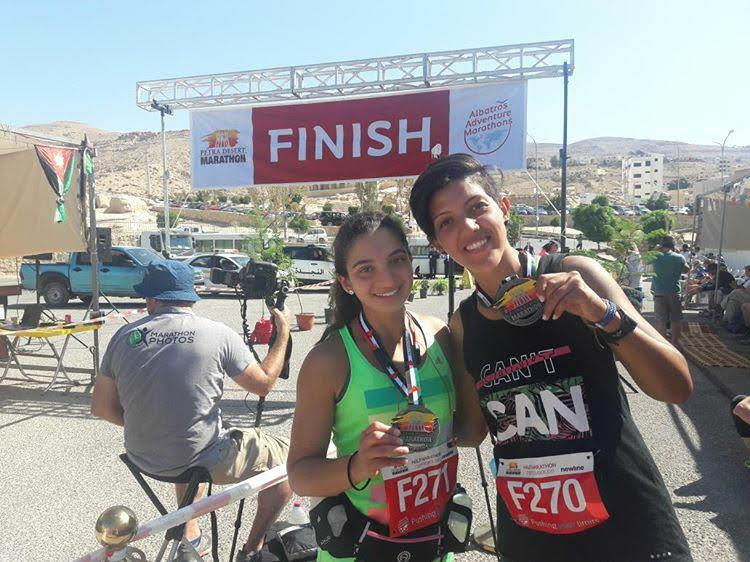
The race started on October 13, 2017, in the heart of Amman’s Old City, amidst its most famous and oldest markets. Mona and I stood side by side at the starting line with dozens—even hundreds—of seasoned runners. My goal was to finish the race within the allotted time limit of five hours, but I finished in two hours and fifty-six minutes. It was an achievement I’m still proud of today, and I was grateful to my friend Mona for pushing me to participate in this race—even if it was by accident. She admitted to me after the race that it was her first half-marathon, too!

The year 2018 rolled around, and I had set new goals and started preparing for the Dead Sea Marathon, but this year I decided to alternate between running to one song and walking to another. I decided to run for two kilometers straight, then walk a little before running another two kilometers, and so on. So Mona and I signed up once again for the half-marathon. The day before the race, I decided I wouldn’t look at my cell phone at all during the race. I’d heard from some people who’d participated before that signs were placed along the course marking the distance covered and the distance remaining—specifically every two kilometers— and that was exactly what I wanted. The race started, and I began running, looking for the first two-kilometer sign. I ran and ran but never reached that sign—at which point I would have switched to walking. I asked some of the race volunteers if we had covered two kilometers, but they said no, so I kept running. I was running at a moderate pace until I reached that sign, but it wasn’t two kilometers—it was five kilometers. I had run five kilometers for the first time in my life without stopping. I felt like a real runner; I had paced myself and maintained a comfortable speed. I didn’t switch to walking but kept running until the fifteenth kilometer, when I felt some pain in my feet, so I had to start walking then. From that experience, I learned the impact of the preconceived notions we plant in our minds. I used to get tired and feel unable to run even one extra meter when a song ended—and I run to the beat of the music. And today, since I didn’t see the 2-kilometer marker I’d been looking for at the start of the race, I ran five kilometers until I saw the sign—no, actually, I ran fifteen kilometers until my feet forced me to switch to walking.
Read more on Urkod The Benefits of Running