
The London Marathon and the New York Marathon
Eleven days flew by, and I found myself in my room in London, packing my clothes and shoes Marathon London set to start the following morning, I was overjoyed and excited; the experience in Paris had given me the confidence I’d lacked before that race. Like a little girl, I went to bed early because I wanted that day to end so that tomorrow morning would come.
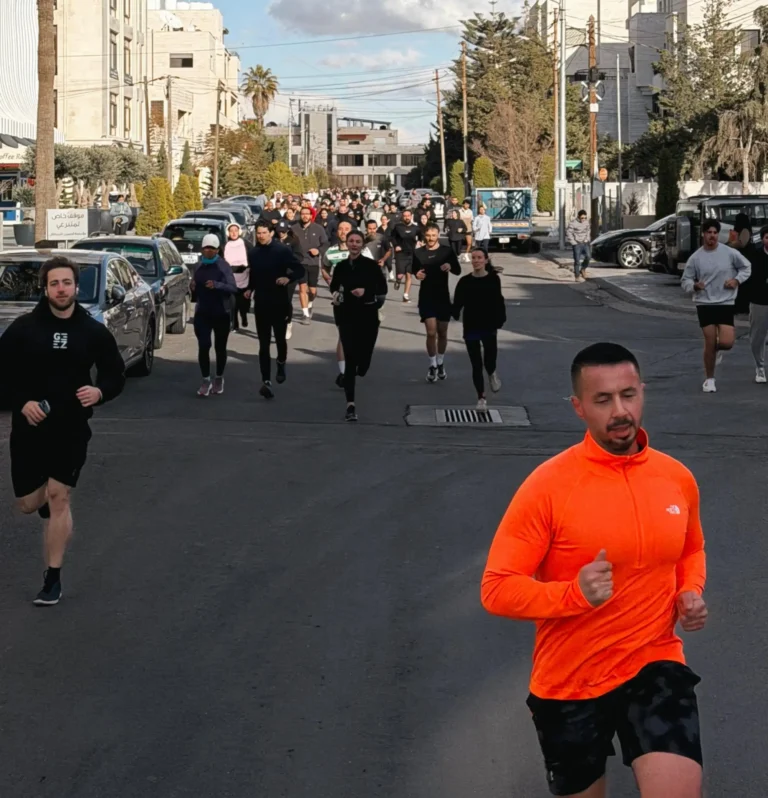
Just as I had done in Paris, I woke up early to get myself and my gear ready for the race. I moved quickly, driven by a great sense of enthusiasm that pushed me to leave my room early and make my way to the starting line. I found that there were more participants than there had been in Paris, but the race route seemed a bit strange to me, since the race start time coincided with the end of a public transit workers’ strike. Since the workers had returned to work just two days before the race, and to avoid disrupting public transportation again in central London, the mayor decided to change the race route. The alternative route was narrow and frustrating, especially with more than 55,000 runners from around the world participating. The race began and the runners started running. It was difficult to find a foothold, and the close proximity of the runners to one another led to collisions and stumbles, especially just past the starting line. The start bothered me, especially when I compared it to the start of the Paris Marathon. I ran the first ten kilometers fairly well, but I felt some pain in my knees. I kept running, and the pain began to intensify. It felt as if someone were hammering them with a hammer with every step I took, and I still had thirty-two kilometers left to run. I started having an internal dialogue—something that naturally happens to anyone who runs long distances. Should I drop out? Of course not. I’m not the type to give in to knee pain, and don’t you dare bring this up with me again, my mind. You know that’s not in my nature, and I’m not the type to quit,” I replied. “But the pain is intense,” it said. “When will this race end?” I asked. “It’ll end—even if we have about three hours or more to go—but it’ll end. And then we can rest. But for now, I have to keep going.” Race to finish I said, “Goodbye,” and I bid farewell to the voice inside me that had been talking to me, and tried to focus on the race.
At the 20-kilometer mark, my inner voice started talking to me again: “You’re suffering.” And even though that was true, I replied, “No, I’m not suffering,” and quickly ended the conversation. I started encouraging myself so I could keep going. “You can do this. You did it easily less than two weeks ago, and you can do it today, too.” My knees spoke up and said, “But what about me? “I can’t take all this pain.” I said, “It’s okay, you’ll be fine. I promise you plenty of ice and cold water as soon as we get back to the hotel. I know the pain is intense right now, but it’s just an hour of pain, but the pride that follows will last every hour, forever. I’ll also tell people about you two and say that you were exceptionally strong and endured so much so that we could accomplish this together.” One of them silenced me with a pain that made it impossible for me to keep running. “Okay,” I told myself, “It’s okay, I’ll stop running for a bit and walk for a few minutes.” After a while, I started running again, but I quickly had to switch back to walking once more. This happened more than once. My struggle continued nonstop throughout the race. I ran for a while and walked for a while, and I was ready to crawl if necessary to finish this race. What I started, I had to finish—that’s who I am, and that’s just my nature.

I crossed the finish line after five hours and ten minutes. I was thrilled to have completed the second marathon of my life, but my legs and knees were killing me—I almost cried from the intense pain. I received my medal and took some photos, quickly gathered my things, and headed back to my hotel room. The pain remained intense throughout the day; I lay motionless on my bed. I felt hungry but couldn’t even get up to eat. I spent most of the day in bed, and if I did get up, it was only once or twice to look out my window—just to move my tired limbs a little—before returning to bed. It was a grueling experience; it was clear that two weeks were definitely not enough for the body to heal itself and regain its energy and health after a marathon.
New York Marathon
In November 2019, after thorough preparation, I participated in the New York City Marathon. I knew the Big Apple (as its residents call it) quite well, and I didn’t feel any tension or anxiety before the race started. I knew that what I’d experienced in London was the result of the short interval between two races that required plenty of rest, I was confident that the race would go well.
I headed to the starting line in the morning. The number of runners was about the same as in Paris and London—around 50,000 or a little more—but there were definitely more fans. Crowds of people lined both sides of the road to cheer on the runners. Oh my God, how I loved that race! Everything was organized in a remarkable way—the fans were amazing, the runners were strong, and the course was beautiful. I really didn’t feel the three hours and fifty-seven minutes it took me to finish my third marathon with my best time ever.
Today, under the exceptional circumstances brought about by the COVID-19 pandemic, I go running at least three times a week, I do it for myself—for my health, strength, and mental clarity—and I do it to prove to every woman and every man that women, just like men, are capable of achieving their dreams and goals, even if they are Arab women from the Middle East. I’m also doing it to prepare for three more upcoming marathons, after which I will become the first Jordanian woman to complete all six major marathons around the world.
In the end, I urge everyone reading this story not to wait for the “right time” to begin their journey toward their dream. Your dream—whether it’s an investment project, a degree you’ve always wanted to earn, or a sport in which you aspire to excel—begins the moment you decide to take that first step toward it. As for success, it is a journey to the summit of a mountain—a journey fraught with difficulties. You cannot climb it with your hands in your pockets. Success is the ally of every hardworking, diligent, and persevering person who pursues their dream tirelessly and without growing weary.
Read more on Run How to Run 5 Kilometers for Beginners
Check out the best nutrition tips at Ola Asaad's Instagram page