A Guide to Proper Stretching After Running
Your fitness tracker beeps, signaling that you’ve reached your target distance. You catch your breath with some difficulty, smile with complete satisfaction, and trudge toward the front door to plunge your exhausted body into the warm water. Mission accomplished, right? Well, the next morning, when you try to get out of bed and discover that your legs have turned into two blocks of concrete, and that your first steps across the room feel like walking on glass, you’ll realize for sure that you’ve made the biggest and most common mistake in the world of running—because you simply didn’t follow the guide to proper post-run stretches.
Running doesn’t actually end the moment your feet stop hitting the ground; it ends when your muscles—which have contracted intensely thousands of times in a row—return to their natural length and flexibility. In this guide—our fourth installment in the Recovery and Movement series—we’ll learn how to reward our bodies after a workout and master the art of “static stretching” to ensure that today’s run doesn’t turn into pain that prevents us from running tomorrow.
Why do we stretch our muscles after the finish line and not before it?
Many runners still stand at the edge of the sidewalk before starting their workout, straining their cold muscles with all their might, thinking that this is the proper way to warm up. As we clearly warned in Link to the warm-up article...Static stretching before a run is the surest way to get a muscle tear. Imagine you’re holding a rubber band that’s been sitting in the fridge for days; trying to pull it hard won’t stretch it—it’ll snap right away.
But after running? It’s a whole different story. Your muscles are now at their hottest, engorged with blood, and the surrounding tissue is extremely sticky and rubbery. At the same time, however, they’re severely “contracted and compressed” from the repeated impact. This is the golden window for recovery; here, sustained stretching acts as a key that reorganizes muscle fibers, helps veins flush out accumulated lactic acid and metabolic waste, and alleviates the fluid retention that causes that excruciating pain the next day.
“The ”Grip” of Asphalt, the Office, and the Heat
We don’t run in state-of-the-art labs or on soft dirt trails in the heart of cold European forests. As runners in the Arab world, we face a harsh, twofold physiological challenge.
On the one hand, we spend long hours of our day in a “desk-bound” position or behind the wheel in suffocating traffic, which shortens and constricts the pelvic muscles. On the other hand, we go out for runs on hard asphalt and unforgiving concrete sidewalks, in temperatures that quickly deplete the body’s fluids and make muscle tissue stiffer and stickier. This harsh combination makes post-run stretching a matter of athletic survival and a mandatory safeguard for preserving your knees—not just an optional way to kill time.
The Six Exercises: How to Relieve Muscle Stiffness?
You don't need to spend a whole hour on complicated stretching sessions; all you need is a smart, direct approach to targeting the muscles that took the biggest hit on the asphalt. Here's the routine that should become an integral part of the end of your workout:
1. Stretching the hamstrings (Hamstring Stretch)
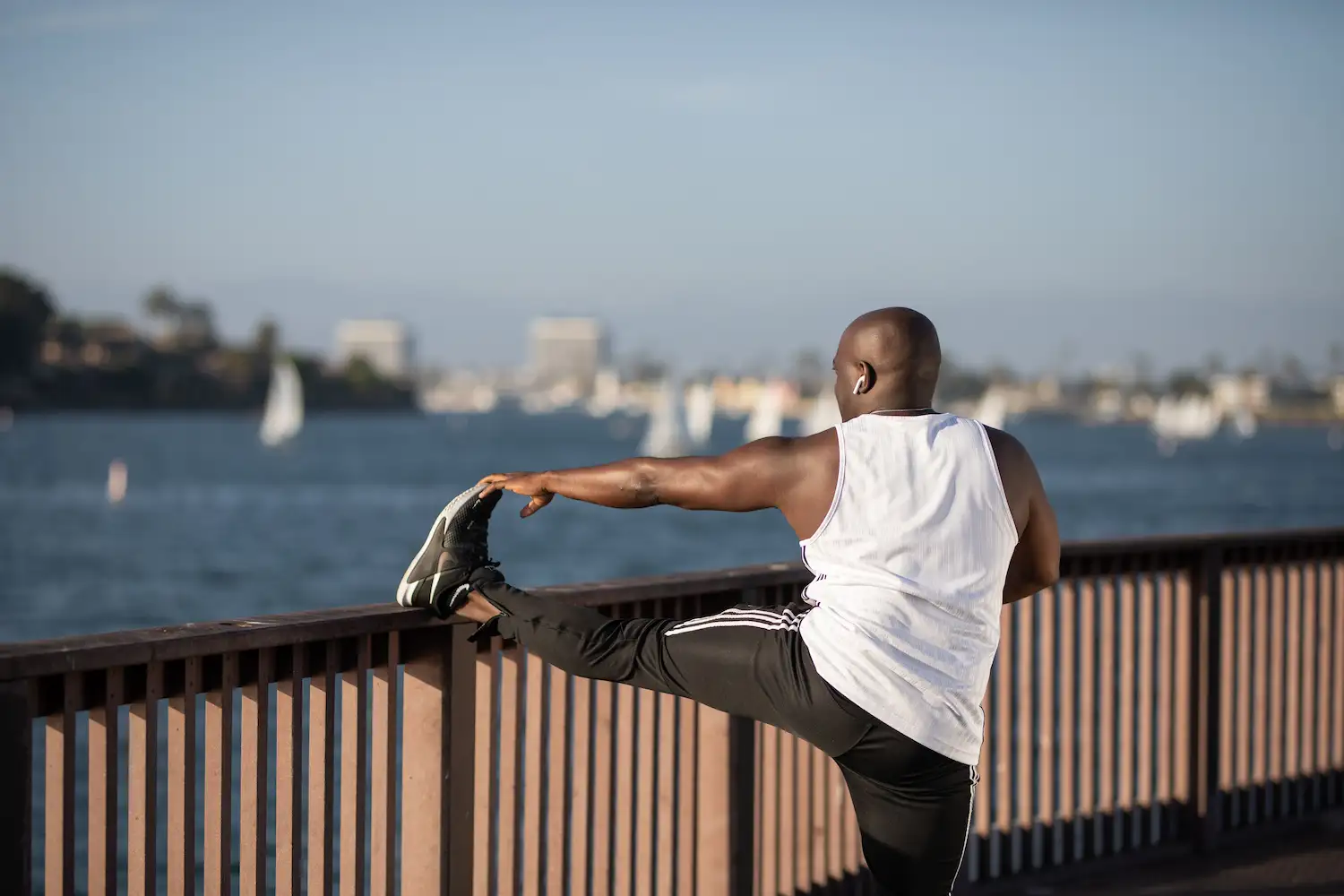
The first to suffer from the impact of hard asphalt are the hamstrings. When these tendons stiffen, they pull your pelvis downward with force, which is the direct cause of most of the lower back pain you experience.
- Application: Sit on the floor and extend one leg forward, then bend the other so that the sole of your foot touches the thigh of the extended leg. Lean your torso forward toward your toes.
- Warning: Don't arch your back or hunch your shoulders in an attempt to touch your toes at any cost. True and effective stretching comes from bending at the hip joint itself while keeping your back straight.
2. Front Thigh Stretch (Quad Stretch)
This massive muscle bears the brunt of the work of lifting your body and propelling you forward, especially if you've just finished intense workouts like sprints or hill running, which we talked about in Link to the article on speed.
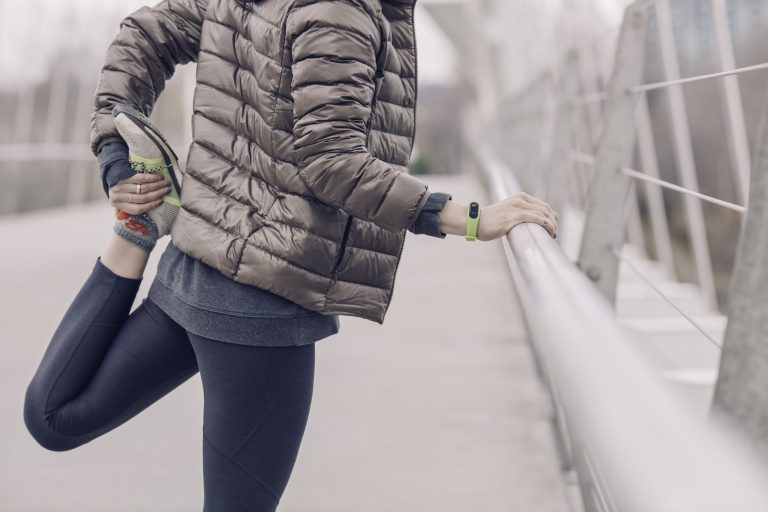
- Application: Stand up straight and rest your hand against a wall for balance. Lift your heel toward your buttocks and hold it with your hand. Gently push your pelvis forward to feel a deep, pleasant stretch in the front of your thigh.
- Warning: Allow your raised knee to move out to the side to make the movement easier. Keep your knees pressed tightly together to ensure full muscle isolation.
3. Prolonging obesity (Calf Stretch)
Running continuously on sidewalks puts a lot of strain on the lower leg muscles. Neglecting these muscles is a fast track to developing “plantar fasciitis”—that burning pain that strikes your heel with your very first step in the morning.
- Application: Stand facing a wall and place your hands on it. Step one foot back a wide step, making sure your heel is fully in contact with the floor. Bend the knee of your front leg and slowly push against the wall until you feel a stretch in your back leg.
- Warning: Lift your heel off the ground—even by just one millimeter—while leaning forward, because that negates the stretching effect from the roots.
4. Hip and Glute Stretches (Hip/Glute Stretch)
The gluteal muscles are your body’s primary powerhouse, but prolonged sitting causes them to stiffen. Tension that builds up here weakens pelvic stability while running, which transfers stress directly to the vulnerable knee joint.
- Application: Lie on your back and bend your knees. Place your right ankle on top of your left knee (so that they form the number 4). Reach in with your hands, grasp your left thigh, and gently pull it toward your chest.
- Warning: Relax the foot of your raised leg. You should flex your ankle (point your toes toward your knee) to protect your knee joint from twisting during the pull.
5. Hip Flexor Stretch
This is the muscle that always gets the short end of the stick. Long hours at a desk keep it tight and contracted all day long. And when you run, this tight muscle prevents you from extending your leg backward comfortably, which completely throws off your running form, just as we explained in Link to the technology article.
- Application: Assume a lunge position with one knee on the floor and the other leg bent at a 90-degree angle in front of you. Keep your torso completely straight, and slowly push your hips forward and down.
- Warning: Don't arch your lower back, thinking you're increasing your range of motion. Tighten your abdominal muscles slightly and tilt your pelvis inward to focus the tension solely on the front of your hips.
6. Lower Back Stretch (Lower Back Stretch)
Running in the sun or in hot weather accelerates your body’s fatigue. And the first thing to suffer is your posture; you start to lean forward, which puts tremendous cumulative pressure on your lower back that needs to be relieved immediately.
- Application: Use the comfortable “child’s pose.” Sit on your knees, then lean your torso forward until your forehead touches the floor, extend your arms as far as possible in front of you while keeping your buttocks touching your heels, and breathe deeply.
The 30-Second Battle: Why Doesn't the Muscle Give In Quickly?
The biggest mistake you can make after overcoming your laziness and starting to stretch is to rush through it. Holding a stretch for just 10 seconds is practically the same as not doing it at all. Why? Because your body has an extremely stubborn innate defense mechanism called the “stretch reflex.” As soon as you start stretching a muscle, your nervous system senses danger and sends an emergency signal to the muscle to contract and resist the stretch in order to protect itself from tearing.
This intense resistance lasts for about 15 to 20 seconds. Once this time has passed, your brain realizes that the movement is controlled and safe, so the muscle relaxes, gives in to the resistance, and begins to truly and effectively stretch. Therefore, the secret to recovery lies in holding each stretch for 30 to 45 continuous seconds, completely calmly, without any swaying or rocking movements, while maintaining deep breathing that supplies the tissues with oxygen.
The Final Step to a Full Recovery
If you’ve followed all of the above, you’re on the right track. You’ve built up your warm-up routine, fine-tuned your pace and technique, unleashed your speed, and now you’ve learned how to reward your muscle fibers with deep relaxation. Your body is now functioning with high athletic efficiency and precision.
But surely you’ve encountered those moments when you discover a stiff “muscle knot” in your glutes or thigh that refuses to respond to any stretching—spots that, when pressed, cause pain that feels like tiny pebbles under the skin. These deep knots require more than just stretching; they need direct intervention.
In the fifth and final stop on our journey, we’ll turn to the most important tool for deep recovery: the “foam roller.” Together, we’ll learn how to give yourself a sports massage that’s both intense and relaxing right in your living room, to release those stubborn knots, say goodbye to excruciating pain, and hit the pavement the next day stronger and lighter than ever before.