A Foam Roller Guide for Runners
A Foam Roller Guide for Runners
You finish your long run, catch your breath with a satisfied smile, head home, and do your usual stretches. On your way to the shower, you catch a glimpse of that foam roller lying in the corner of the room. You look at it for a second, then ignore it, using a lack of time or fatigue as an excuse. The next morning, you try to get out of bed only to discover that your muscles are stiff as a board and your movements are sluggish, and you wonder in confusion, “Why do my legs hurt so much even though I’ve been sticking to all my workouts?”
The answer lies quietly in that corner you’ve overlooked. A foam roller isn’t a luxury accessory we turn to in our spare time, nor is it a tool for the recreational massages you see at spas; it’s a “preventative maintenance” tool that extends your athletic career and saves you from physical therapy clinics. The runner who ignores it allows muscle tension to build up day after day, kilometer after kilometer, until this silent tension turns into a devastating injury. But the runner who uses it regularly has a secret weapon that speeds up recovery and magically reduces pain between sessions.
Decoding Pain: What Does a Foam Roller Do?
To understand the magic of this roller, we need to take a look at what’s happening beneath your skin. Your muscles are surrounded by a flexible connective tissue membrane called “fascia.” With repeated impact against the asphalt and intense exertion, these tissues suffer microscopic tears and lose their elasticity, causing them to dry out and stick together, forming what are known as “trigger points.” These small knots restrict your range of motion, restrict blood flow, and cause that deep, nagging pain.
This is where the foam roller comes in. The steady, controlled pressure of your body weight on this roller breaks up these adhesions deep within the tissue, releases muscle knots, and restores the flow of oxygen- and nutrient-rich blood to the thirsty tissues. This mechanical process is scientifically known as “Self-Myofascial Release.” In short, it’s a process of realigning and reorganizing your muscle fibers so they return to being as smooth and elastic as they were before you went for a run.
Five Key Areas for a Runner's Physical Maintenance
Here’s a practical guide to targeting the five key areas that bear the brunt of the strain when running, taking into account our environment, which compounds the severity of these stresses:
Hamstrings (Hamstrings)
Our Arab streets lack soft running surfaces; long runs on hard asphalt send successive shock waves that are absorbed by these tendons, making them more prone to cramping.
- How to use it: Sit on the floor and place the foam roller under your thighs from behind. Support your weight with your hands behind your back, and lift your pelvis slightly. Slowly roll the foam roller from under your buttocks up to just before the back of your knee.
- Common mistake: Roll back and forth quickly, as if you were kneading bread. Rolling quickly won't release the deep tissues or break up the knots.
Quadriceps
Severe tension builds up in this massive muscle, especially after you've pushed your body to its limits—as happens when you do the sprint and hill climb exercises we discussed in detail in The Essay on Speed and Strength.
- How to use it: Lie on your stomach, propped up on your forearms, and place the roller under the front of your thighs. Roll your body very slowly from the top of your hip down to just before your kneecap.
- Common mistake: Rolling the roller over the kneecap (patella) itself is very painful and can damage the joint. Always stop before you reach the kneecap.
The iliotibial band (IT Band)
Neglecting this tendon is the primary cause of “runner’s knee” (sharp pain on the outer side of the knee). The uneven and hard sidewalks in our cities force this tendon to work twice as hard to maintain balance with every step.
- How to use it: Lie on your side and place the roller under the outside of your thigh. Support your weight on your forearm, and bend your upper leg so that your foot rests on the floor in front of you to relieve pressure. Roll slowly from just below the hip to just before the outer knee.
- Common mistake: Not using the upper leg to absorb some of the weight. Putting your full body weight on this string can be painful, so use your free leg to control the amount of pressure.
Calves
This muscle is your first line of defense against the impact of hard asphalt. And if you've recently started adjusting your foot strike to land on the midfoot, as we advised you in The Article on Technique and Rhythm...you'll need to rest this muscle every day, as neglecting it is the direct cause of plantar fasciitis.
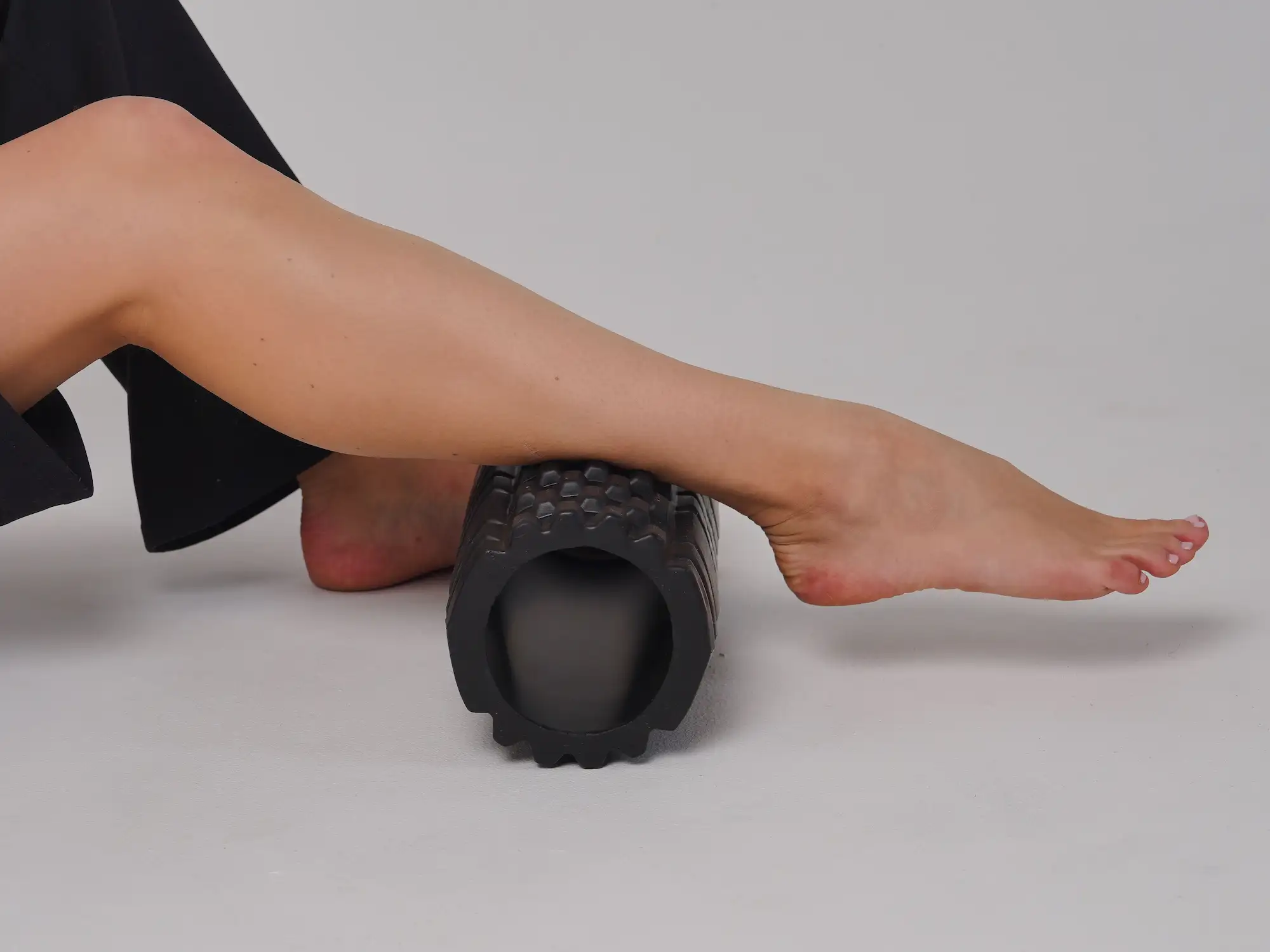
- How to use it: Sit down and place the roller under the back of your calf. To increase the pressure, you can cross one leg over the other. Roll slowly from below the knee to just above the ankle.
- Common mistake: Simply rolling the middle part of the gluteus maximus and forgetting to rotate the leg to the right and left to target the lateral fibers, which bear a tremendous amount of tension.
Upper Back and Shoulder Muscles
As fatigue sets in and you run in hot weather, your core posture collapses and your back rounds forward. A foam roller works like magic here to open up your chest and realign your spine.
- How to use it: Lie on your back and place the roller under the middle of your back (between your shoulder blades). Clasp your hands behind your head to support your neck, bend your knees to lift your pelvis, and then slowly roll back and forth.
- Common mistake: Roll the roller down to your lower back (the lumbar region). The lower back lacks sufficient bony support, and putting your weight on it could injure your vertebrae.
How to Use It: When and for How Long?
The use of a foam roller depends on timing to achieve different goals:
- Immediately after running: This is the ideal time to speed up recovery and release deep-seated tension before the muscles stiffen.
- On days off: Use it as a standalone maintenance session to maintain tissue elasticity and stimulate blood circulation.
- Before running (for warm-up only): You can use it before taking off as part of the preparation routine we learned in Warm-up Article, but only if the rolling is light and quick to stimulate blood flow, and you avoid deep pressure that could relax the muscle and cause it to lose the strength needed for running.
Correct duration:
The biggest secret lies in moving slowly. Spend 30 to 60 seconds on each area, moving deliberately at a rate of one inch per second. And when you come across a sharp pain point (a muscle knot), don’t avoid it! Pause there, hold still over the painful spot, and breathe deeply and steadily until you feel the tension begin to melt away and relax under your weight.
The Three Dangers on Our Streets
If you’re a runner in the Arab world, a foam roller should always be in your room. Every day, we face environmental and lifestyle challenges that compound our muscular discomfort; we spend long hours sitting at a desk that restricts our movement, then go out for a run on hard asphalt that doesn’t absorb shock, all while enduring high temperatures that accelerate dehydration and cause muscle tissue to stiffen and stick together. This “trinity” makes the foam roller an absolute necessity for survival—not just a luxury addition to your training routine.
The Complete Running Workout Series
- Warm-up Exercises Before Running
- Running Technique Exercises
- Speed and Strength Exercises
- Stretching Exercises
- Foam Roll Guide (This Article)
Your arsenal is complete... Now it's your turn
As you read these lines, the picture is complete, and the circle of knowledge we began together is now closed. We embarked on a long journey to build an unbeatable runner; we began By aligning and securing the joints, and then we reengineered The Mechanics of Your Movement To make it flow, and then we let it run wild For Your Explosive Power, and we learned the art of calming the body through Long-form article...And today, we'll wrap up the routine with deep tissue recovery using a foam roller.
This is the solid foundation upon which a true runner builds. You are no longer running haphazardly; you now have the knowledge, technique, and recovery tools that will ensure your longevity for years to come. The complete system is now in your hands.
Run… Start your story.